Paradise Guitar Studio - My Thoughts
Hello all. Before I jump into this, be certain that I understand that for some, the idea of using a virtual amp, cabinet and microphone are not in your plan. To this I say, be yourself and don’t kowtow to anyone else’s direction.
With that done, I wanted to take a quick look at the newish release from Universal Audio called Paradise Guitar Studio. This is a plugin that works (of course) in UA’s excellent LUNA DAW but also in other DAWs. For my evaluation I used both LUNA and Logic Pro. BTW you don’t have to record anything so long as software monitoring is active in the DAW so you can hear the impact of the plugin in your speakers or headphones. I will recommend that if you use headphones use the around the ear type for best sound. For speakers in this case, I used my KRK monitors and was quite happy.
Routing
It’s pretty simple really. Plug your guitar into the High Z input on your interface. I was using a Universal Audio Apollo Twin X connected to a Mac Studio but really any decent supported interface into any supporting OS will do. UA’s Spark subscription offers support for both Windows and macOS so that should cover most everyone. If you are a dedicated Linux person, I did not look into this at all.
In your DAW, enable the Paradise Guitar Studio plugin on a Line In track.
Set your interface input and output levels to high enough for decent sound without clipping and away you go.
Amplifiers
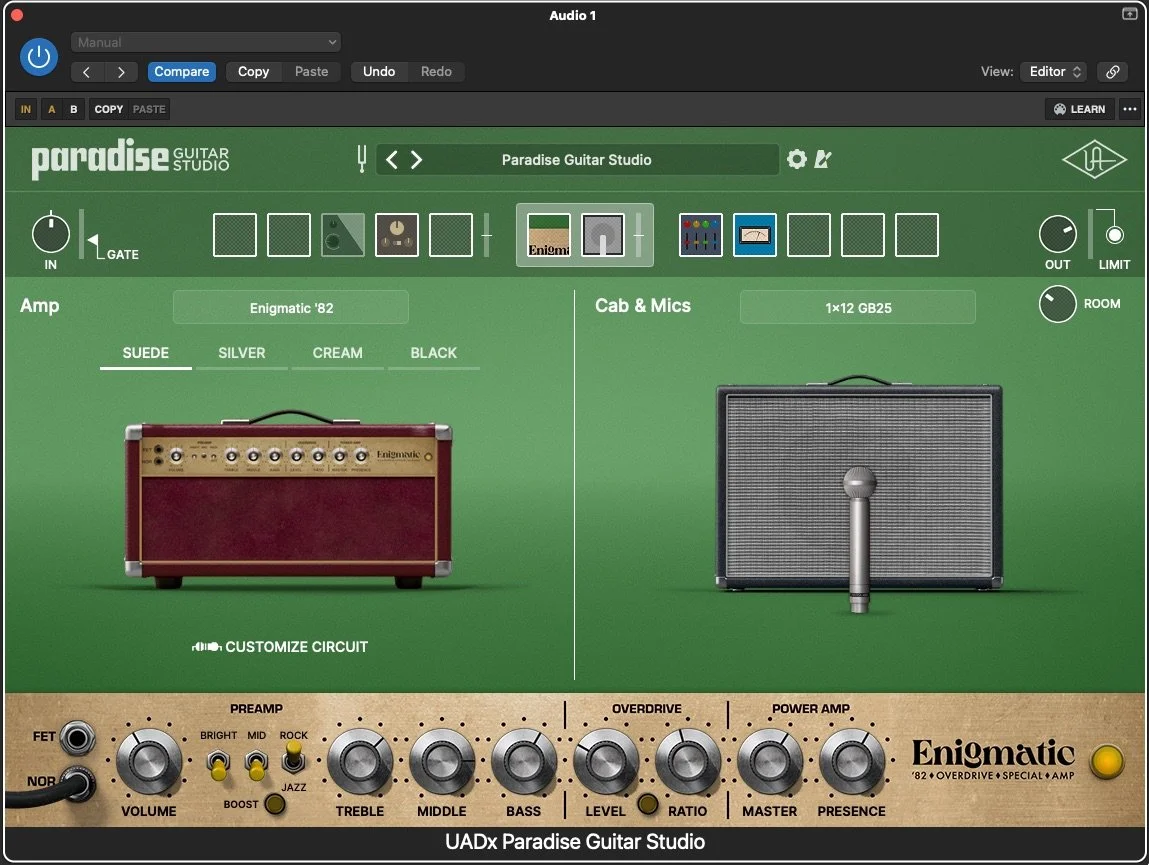
Paradise Guitar Studio draws heavily on UA’s existing amp plugins that are also found in their superb stompboxes. There is a 50’s era Fender tweed called the Woodrow. Think 5E3. There’s the ’63 Ruby which does, in my opinion, the best simulation of a VOX AC30. I find that most amp sims fail when trying to be an AC30. This one is as close as I have come. Then there is the ’65 Dream which is a fine sim of the Fender 1965 Blackface Deluxe Reverb. It also includes the recently released Showtime plugin that beautifully emulates a Fender Showman amplifier. For the heavier stuff, although it does a lovely clean, there is the Lion, which is a 1968. Marshall Super Lead simulation. This comes in Lead, Brown and Bass flavours. The final sim is UA’s ’82 Enigmatic, which covers a series of different Dumble amps. I’ve never played through a real Dumble, but I will say that this plugin produces a beautiful tone that is darn close to Dumbles that I have heard on record. There are four different Dumble flavours including Suede, Cream, Silver and Black iterations.
Cabinets
Typically in the real world we find amps with built in speakers in combos or separate heads and cabinets. Paradise Guitar Studio separates the amp portion from the speaker portion so you can pair any amp with any cabinet in the software’s repertoire that I found to be particularly interesting. Not all sound great to be sure, but some, like the Woodrow into a 4x12 do provide one with flexibility that would be hard to deliver in the real world without some engineering talent and connectivity skill. Provided are a selection of cabinets with single speakers, two speakers and four speakers in multiple cabinet / microphone variations. Each has its own tonal quality, so users will find something that suits.
Microphones
As Paradise Guitar Studio is built to be an all in one recording platform, it also includes a variety of different microphone emulations. I use the UA Hemispheres tool in the studio with the UA microphones and find that I get the sound and feel of different microphones easy to obtain with a high level of accuracy. Those microphones are also in Paradise Guitar Studio, so you also have the option to choose which microphone you will use to mike the cabinet. There is also a DI option that eliminates the cabinet and the microphone from the signal chain. Microphone sims include the SM57, Royer 121, Beyerdynamics 160, 414 Condenser, 421 Condenser and 67 Condenser. Do note that microphones are not individually selectable and are paired with cabinets in a microphone / cabinet selection capability. None are weird and all sound very good.
Effects
Given the all in one idea, there are a number of stompbox sims as part of the product. While not as many as in some other tools, these sound bang on and I will take quality over quantity every time. For copyright reasons UA cannot call the sims by the names of the pedals but it’s pretty easy to figure out which real world pedals these sims emulate.
Drive / Distortion
TS OD, Gold OD, Big Fuzz, RAW Distortion, Nashville OD, Vintage Fuzz
Modulation
Brigade Chorus, Orange Phaser, Blue Flanger, Multi-Chorus, Vintage Vibrato, Trem 65, Micropitch Shifter
Dynamics
Red Comp, 1176 Compressor
Delay
Analog Memory Delay, EP-III Tape Echo, Plate
Digital Delay
Pitch Shift Delay
Reverb
Spring 65 Reverb, Digital Reverb, Plate 140 Reverb, Reverb 224
Tone / Filter
10-Band Graphic EQ, Studio EQ, Volume
Wrapping Up
As Paradise Guitar Studio is a plugin, you have the option to have it active during recording, or you can record the guitar completely raw and then activate the plugin during the mix if you want to try different options as part of your total song. For recordists, this latter option may be preferable, to each his or her own. While I am not biased in favour of Universal Audio solutions, I have yet to find one that doesn’t deliver on its promise and while there may not be as many options as with other vendors, it is my perspective that what you get is superlative quality over quantity. Moreover, UA has revised their delivery and pricing model to create the Spark system which while being a subscription, does give you a ton of really fine plugins for a fixed monthly price. Moreover, nothing in Spark requires the presence of UA interfaces, which for the new user or anyone not wanting to pay the premium for UA’s in unit CPU interfaces, a lot more options. UA does have a full line of USB based interfaces without the internal UA CPUs. These interfaces cannot use the old UA plugins because they do not have the requisite internal CPUs. However as simple interfaces they work extremely well. The USB units are a lot less expensive than the Thunderbolt versions which will be a benefit to those on a budget.
I respect that Paradise Guitar Studio will not be for everyone, particularly those who prefer physical amps and effects. And yes it does require a computer and a DAW to be effective for recording and you can certainly use it for live play as well, taking the output from the interface and sending it to the house PA. From my perspective, I like it a lot. Superb sound, lots of choices but not so many as to induce option paralysis and backed up by the experts at Universal Audio. There are also introductions by James Santiago on the Universal Audio website at https://uaudio.com that are worth your time.
Thanks for reading and supporting my work.